AmeraLabs 3D Printing Resins: Performance, Applications, and Product Insights

Overview of AmeraLabs and Its Resin Technology

AmeraLabs is a specialist manufacturer focused on advanced 3D printing resins for demanding users. The brand is known for pushing the limits of resin printing by engineering materials that deliver predictable results across many resin printers. Instead of offering countless resins with minor differences, AmeraLabs develops carefully tuned products that target real workflows: tabletop miniatures, dental model production, and fast prototyping. This strategy makes every ameralabs resin feel purpose-built, with consistent curing behavior, strong layer bonding, and a finish that supports high visual fidelity.

What users often highlight is the mix of incredible quality and everyday practicality. In AmeraLabs materials, print quality is not a marketing promise but an engineering priority. Many users describe the materials as extremely reliable, because they maintain stable exposure response even during long sessions. The result is a smoother printing workflow, fewer failed builds, and more time spent designing or producing rather than troubleshooting.

Company background and product focus

AmeraLabs operates with a clear market focus: professional-grade materials for LCD, MSLA, and DLP technologies. The company’s research aims to improve printing speed without sacrificing precision, leading to blends that can deliver incredible speed combined with excellent detail. This dedication helps users reach faster print times while keeping edges sharp and surfaces uniform. In practice, an ameralabs resin is meant to help you print effortlessly, not force you to fight the material with endless setting tweaks.

Key advantages of AmeraLabs resins

The key advantages revolve around detail, strength, comfort, and stability. First, the materials support fast printing through optimized reaction kinetics and fast polymerization. Second, they enable accurate reproduction of micro-geometry, which is why AmeraLabs is favored for printing miniatures, dental model resin work, and high-precision prototypes. Third, many blends are formulated as low odor resin solutions, improving user comfort in studios and home environments. Finally, AmeraLabs targets consistent curing speeds and strong interlayer adhesion so users can build stable models that survive handling, post-processing, and real use.

TGM-7 Resin for Tabletop Miniatures

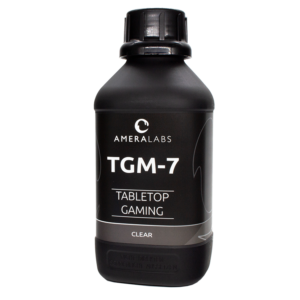
TGM-7 is the flagship choice for tabletop creators who demand high detail and durability. It is widely used in tabletop gaming and the miniatures industry because it balances accuracy with toughness. Within the AmeraLabs portfolio, TGM-7 is a refined model resin that helps users achieve detailed miniatures without brittle failures. If your goal is printing tabletop gaming pieces that look crisp and survive repeated play, TGM-7 is engineered for that exact purpose.

Material properties: flexibility, detail, and curing speed

In terms of mechanical behavior, TGM-7 is a slightly flexible resin with a carefully tuned modulus. This gives miniatures better impact resistance than many standard blends while still capturing fine lines. Users typically note that printing resin captures surface texture extremely well, keeping facial features and armor patterns clear. The formulation also supports fast curing resin behavior, enabling faster print times and improved efficiency during large batches of tabletop gaming miniatures.

Compatibility with LCD and DLP resin printers

TGM-7 is compatible with the vast majority of modern resin printers, including LCD and DLP systems. The resin responds well to typical 405 nm workflows, and it remains stable even as temperature or load changes. When paired with correct exposure, it helps you print effortlessly and maintain consistent print times from one project to the next.

Ideal use cases: gaming miniatures and wargaming

The most common use case for TGM-7 is the creation of gaming miniatures for RPGs and wargames. Makers printing armies for heated gaming sessions rely on the resin’s toughness to protect miniatures from snapping at thin areas. It also excels in props and terrain pieces, where users want a clean matte finish and dependable surface quality.

Post-processing: IPA cleaning and UV post-curing

With TGM-7, post-processing is straightforward. Most users do a quick IPA rinse, then UV cure for a stable final state. Because the resin is formulated for consistent curing resin behavior, it reaches full hardness evenly, avoiding soft edges. This makes it ideal when resin captures of tiny details are critical. After curing, miniatures remain slightly forgiving, helping to preserve delicate supports or weapon tips.

Technical specifications: Shore D hardness, tensile strength, and viscosity

On the technical side, TGM-7 has a Shore D hardness tuned for handling rather than pure brittleness. Tensile behavior supports thin walls, and viscosity remains low enough for smooth drainage, contributing to good printing speed and stable layers. In real use, this supports miniature printing quality and high detailed models across different slicer profiles.

DMD-31 Resin for Dental 3D Printing

DMD-31 is a specialized solution for medical and dental use. It targets high precision in dental model production, where dimensional stability matters more than cosmetic freedom. As a professional dental model resin, DMD-31 is optimized for dental printers and delivers strong contrast for scanning, alignment checks, and model creation. The resin supports consistent surface quality so labs can rely on repeatable results.

Precision and surface quality for dental models

In dental workflows, predictable surface quality is essential for fitting and occlusion checks. DMD-31 gives an outstanding surface quality with minimal stepping, allowing clean margins. Many labs use DMD-31 as their everyday quality resin because it maintains crisp geometry at low layer heights. This combination leads to incredible quality across both small crowns and full-arch models.

Compatibility with DLP dental printers

DMD-31 is designed to work smoothly with pro-grade DLP dental printers, including systems tuned for rapid cycles. It offers dependable curing speeds, encouraging fast printing without distortion. Users who need a reliable, high-throughput workflow note the resin’s incredible speed combined with model integrity.

Benefits for dental labs and model production

For labs, DMD-31 produces stable, clean models that hold sharp edges after cure. It supports dental model production at scale and helps teams shorten turnaround thanks to faster print times. Because it is a true dental resins solution rather than a re-labeled general blend, it provides an ideal dental model foundation for aligners, surgical guides, and diagnostic references.

AMD-3 Resin for Prototyping and Production

AMD-3 fills the gap between casting detail and functional engineering. It is meant for users who print prototypes, validate parts, and move to short-run production. As a robust brand resin option from AmeraLabs, AMD-3 maintains dependable accuracy while pushing printing speed higher than many traditional blends. This is why many engineers describe it as a reliable resin for everyday development.

High-speed printing and fine detail resolution

AMD-3 is tuned for incredible speed and clean edges, helping teams reduce costs in iterative design. Through controlled fast polymerization, it supports fast printing without “mushy” detail. This makes it suitable for enclosures, mechanical fixtures, jigs, and functional prototypes where both print quality and efficiency matter.

Applications in short-run manufacturing and prototyping

The material is used for printed resin parts in low-volume manufacturing, especially when users need consistent dimensioning. It is also popular for aesthetic prototypes because the surface is smooth, low-odor, and paint-friendly, allowing quick finishing and client demos. If your priority is to print prototypes rapidly while preserving accuracy, AMD-3 is a proven choice.

Key Performance Features of AmeraLabs Resins

Across the lineup, AmeraLabs emphasizes a practical mix of detail and efficiency. Users often compare AmeraLabs to countless resins in the market and note that these materials deliver higher consistency per liter. Whether printing miniatures, dental models, or prototypes, AmeraLabs focuses on predictable exposure response, minimal shrinkage, and clean finishing.

Fast curing for reduced print times

AmeraLabs materials are frequently described as fast curing resin solutions because they reach full polymer conversion with stable energy doses. This supports faster print times, decreases peel stress, and reduces the chance of mis-layers. In real terms, a well-tuned ameralabs resin can offer incredible speed combined with consistent shapes, meaning your models finish sooner without losing definition.

High detail printing for intricate models

High detail is the signature trait of the brand. AmeraLabs resins are designed so that printing resin captures micro-features rather than smoothing them away. The result is high detailed models that match CAD intent, with clean corners and stable thin walls. This advantage shows up strongly in printing miniatures and dental model production, where details are measurable and visible.

Low odor and paintable surfaces for user comfort

Many blends are formulated as low odor resin options, which helps creators who print in small studios. After curing, the surface remains slightly matte and receptive, making it easy to prime and paint. For hobby users, that means smoother workflows in tabletop gaming projects, and for engineers it means quick finishing with minimal sanding.

Resin surface finish and stability

AmeraLabs targets consistent surface quality and dimensional stability, especially in thin structures. This is why users call these materials extremely reliable. The layers bond in a controlled way, creating stable models that survive handling. For miniatures, this helps prevent support scars. For dental work, it ensures clean margins. For prototypes, it protects functional tolerances.

Best Practices for Printing with AmeraLabs Resins

Recommended 3D printing settings

To get the most from any ameralabs resin, start with the manufacturer’s baseline profiles, then fine-tune exposure in small steps. AmeraLabs materials tend to respond linearly, so small changes yield predictable results. This makes it easier to dial in printing speed and reduce total print times without causing overcure. Keep lift speeds moderate to preserve detail, then optimize once the workflow is stable.

Support structure configuration tips

Support needs vary by model type. For printing miniatures with TGM-7, use more but thinner contact points to minimize scars. For dental models with DMD-31, prioritize rigidity to avoid flex during peel. For prototypes with AMD-3, supports should distribute load evenly to preserve flatness. Across all cases, good supports help the resin print effortlessly and avoid distortions.

Post-curing and cleaning procedures

Wash prints thoroughly, then cure at the recommended wavelength. AmeraLabs blends are engineered for stable curing resin behavior, so they reach full strength with proper UV. Avoid overcuring thin miniatures, since excessive exposure can reduce flexibility. For production parts, a full cure ensures maximum durability and impact resistance.

Applications Across Industries and Hobbies

Tabletop gaming and miniature printing

AmeraLabs is widely used for tabletop gaming and tabletop gaming miniatures. Creators value that TGM-7 supports miniature printing quality with crisp detail. The resin’s resilience helps protect miniatures during transport and intense play. Whether building custom armies for titan forge style sets or unique kitbash figures, the material preserves sharp lines and long-term durability.

Dental model production and prosthetics

Dental labs depend on DMD-31 for accurate dental model production. With fit-critical parts, the resin’s low shrinkage and clean finish are essential. As a consistent member of dental resins categories, it is engineered for scanning-friendly geometry and repeatable color tones across batches.

Prototyping and small-scale manufacturing

Engineering teams appreciate AMD-3 for fast cycles and robust parts. It supports iterative projects where teams must print prototypes quickly, compare assemblies, then move to small-batch output. Because material behavior is predictable, users can plan schedules confidently and hit deadlines with fewer failed prints.

Considerations and Limitations

Resin fragility and moisture resistance

No resin is perfect for every task. Even durable blends can become brittle if overcured or stored poorly. Miniatures printed with TGM-7 remain tough, but thin tips may still snap under extreme bending. Dental models made from DMD-31 are accurate, yet they are not intended for high-impact mechanical use. Prototypes from AMD-3 are robust, but like most quality resin products, they can absorb moisture over very long exposures. Keep prints dry and sealed when needed.

UV wavelength compatibility and storage tips

AmeraLabs resins are optimized for common 405 nm systems used by most resin printers. If you are using a niche wavelength or older machine, test first. Store bottles in a cool, dark place, and mix gently before each use. Correct storage keeps curing speeds and overall print quality stable, extending shelf life and reducing waste.

Future Developments and Product Innovations

Emerging trends in resin formulation

Resin technology continues to evolve toward higher efficiency, lower odor, and better mechanical performance. Expect AmeraLabs to push deeper into blends that deliver incredible speed without losing detail. Trends also include tailored surface chemistry for smoother resin art finishes and improved stability for industrial output.

Potential applications and industry expansion

Future AmeraLabs development may extend into reinforced engineering resins, high-temperature blends, and expanded dental lines. As printers get faster and sharper, materials must match. AmeraLabs already demonstrates an ability to scale from hobby to clinic to factory. This positions every new ameralabs resin release as a potential benchmark for the market.

Deep Dive: Extended AmeraLabs Lineup

Beyond the three flagship materials, AmeraLabs offers other specialized products developed for niche needs. These include XVN-50 for high-precision functional parts, AmeraLabs SiOmaster for silicone mold master production, and DMD-21 for streamlined dental modeling. Users who incorporate these variants into their workflow benefit from the same consistent curing logic and dependable finish as in the core lineup. For many studios, adding XVN-50 or AmeraLabs SiOmaster widens the range of projects they can handle without changing supplier ecosystems.

In practice, XVN-50 is favored when users want a stiffer, more dimensionally stable print with very clean edges. AmeraLabs SiOmaster is aimed at creators preparing high-detail masters for silicone casting, especially in prop-making or artisan manufacturing. DMD-21 complements DMD-31 by offering an alternative balance between visual clarity and speed for dental labs.

frequently asked questions (FAQ)

What makes ameralabs resin different from other brands?

An ameralabs resin is engineered around predictable curing, high detail, and real-world reliability rather than aggressive pricing or endless product variations. Users notice incredible quality, stable curing speeds, and fewer failures. The goal is to support a smooth resin printing process so you can focus on outcomes, not constant troubleshooting.

Is AmeraLabs good for printing miniatures and tabletop gaming?

Yes. TGM-7 is designed for printing miniatures in tabletop gaming workflows. It offers high detail, strong impact resistance, and consistent surface quality. Many users report excellent miniature printing quality that holds up through repeated use and heated gaming sessions.

Which AmeraLabs resin is best for dental labs?

DMD-31 is the primary choice for dental model production. As a purpose-built dental model resin, it provides crisp details, smooth surface quality, and predictable fit. Some labs also use DMD-21 for alternative dental cases requiring a slightly different balance of speed and finish.

Can AmeraLabs resins reduce print times?

AmeraLabs materials are optimized for printing speed. Many users experience faster print times because the resins behave as fast curing resin blends. This enables fast printing while keeping parts accurate, especially when settings are tuned carefully.

Do AmeraLabs resins work on all resin printers?

AmeraLabs resins are compatible with most 405 nm LCD and DLP resin printers. Always confirm exposure ranges for your machine, but in general, AmeraLabs is known for being extremely reliable across platforms, from entry-level desktop systems to professional dental printers.

What is XVN-50 used for?

XVN-50 is used for high-precision functional and engineering parts where stiffness and dimensional stability matter. Users often choose XVN-50 when they need a dependable finish and accurate geometry for prototypes or short-run parts. It supports strong print quality and consistent output.

Why choose AmeraLabs SiOmaster?

AmeraLabs SiOmaster is intended for creating masters for silicone molding. If you produce castable prototypes, artisan pieces, or need clean master geometry, AmeraLabs SiOmaster provides reliable detail and smooth finishing after curing.

How does DMD-21 differ from DMD-31?

DMD-21 complements DMD-31 by offering a different performance balance for dental labs. Both are in the dental resins family, but DMD-21 may be selected where users want a quicker workflow with stable accuracy for specific model types.

Is AMD-3 suitable for functional parts?

Yes. AMD-3 is a robust choice to print prototypes and functional models. It supports incredible speed combined with consistent toughness. Users trust AMD-3 as a reliable resin for iterative engineering and small-scale production.

AmeraLabs continues to stand out in the world of resin printing by offering materials that combine consistent curing, high detail, and real mechanical performance. Whether you rely on TGM-7 for tabletop gaming miniatures, DMD-31 or DMD-21 for professional dental model production, AMD-3 for fast prototyping, or specialized blends like XVN-50 and AmeraLabs SiOmaster, you get the same focus on stability and dependable results. With careful settings, proper post-curing, and good storage, AmeraLabs resins can help you reach incredible quality, fast printing, and a workflow that feels genuinely print effortlessly from start to finish.

SHOPPING CART

close
Join Waitlist We will inform you when the product arrives in stock. Please leave your valid email address below.